
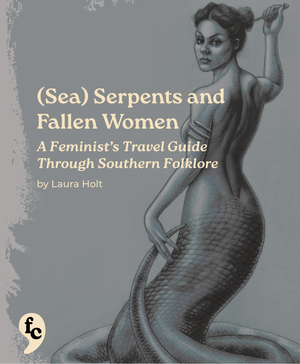
by Laura Holt
“First thing I noticed was the dead stillness. Not a frog was chirping, nor nary a fish biting. The only sound was this odd humming coming from somewhere in the reeds, low and hypnotic, sorta like a snake hiss, but not like any snake I'd ever heard… When I saw it, I couldn't believe my eyes. It was a monster with a long body covered in scales and a haunting humanoid face… It looked at me, and I looked at it, and I thought for sure I was going to die. Then it sank back into the river, and I hightailed it home and never went fishing there again.”
~ Abbreviated firsthand account of my grandaddy’s encounter with the Altamahaha
Lamia. Naga. Yacumama. No matter what you call her, nearly every culture in the world has at least one story about a man-eating water serpent that either resembles or takes the form of a beautiful woman to lure her prey to their demise. In African folklore, she is known as Mami Wata. In Greek mythology, Hesiod referred to her as Echidna, mother of monsters, and in ancient Mesopotamia, she was worshipped as Tiamat. Here in the south, though, we call her Altie.
If you have never been to a small, coastal Georgia town, you are missing out. Palm trees bow to large, twisted oaks draped in Spanish moss outside colorful colonial homes with American flags on every lawn. Local stores sell everything from books and antiques to shells and kitschy bumper stickers, and the air smells of salt and brine from the Altamaha River, which runs from Wheeler County down to the town of Darien, where it empties into the Atlantic.
As I pass over the bridge that spans the marina, it’s like I'm entering another world. One where being on the water is as much a way of life as breathing, and your health is at the mercy of a natural force that can be both benevolent and merciless. My first stop is the Visitor’s Center, where I am greeted by a life-size model of Altie, aka the Altamahaha, as she’s formally called. Though she looks a little different than the creature my grandaddy described seeing as a boy—more plesiosaur than Melusine—I nonetheless pose for a selfie before taking in the rest of the exhibit. After all, if there is an aquatic monster lurking in the depths of Georgia’s waterways, I aim to find it.
The display labels I read seem to line up with the eyewitness accounts listed on the town’s website, which has an entire page dedicated to its resident cryptid. Most of the sightings of this alleged beast occur on or around Fort King George. Yet after making the drive, paying the $5 entry fee, and trekking through alligator-infested trails, while I do spot something large in the water from a vantage point atop a lookout tower, I’m not entirely convinced it wasn’t just a log.
Back at square one, I can’t help but wonder if there isn’t more to this female-serpent-monster myth than meets the eye. Fortunately for me, Darien is right in the middle of its annual Blessing of the Fleet festival, making it the perfect time to immerse myself in the local culture. So, after snagging a homemade ice cream cone from a vendor’s cart, I take to the streets to see what the town has to teach me. It doesn’t take long before something jumps out at me from the wall of a small art gallery: the image of a woman with long golden hair standing in a lush garden under an apple tree, a large green serpent with the face of a female twined around her arm.
Like most people who grew up in the Bible belt, my Sundays have often been spent at church. So, I know the story well: of how God created the first man and woman in the Garden of Eden. How the woman, meant to be a helpmate to the man, was tricked by a talking serpent into eating the forbidden fruit, resulting in humanity being cast out of paradise. But what if the fall didn’t happen the way we were taught, and the truth ties back to one real ancient historical event that has led to every other story about evil, snakelike women since then?
What if the apple wasn’t an apple at all, but a metaphor for stolen innocence? And what if that innocence didn’t start with Eve?
I was a senior in high school when I first heard the story of Lilith. Found in the Jewish Talmud, recreated in The Epic of Gilgamesh, and mentioned in the Bible, she is the first wife of Adam, not Eve, in accordance with Genesis 1:27: “Male and female, He created them.” In this version of the creation myth, God made the first man and woman out of clay as equals, but when Adam tried to dominate her sexually, Lilith fled the garden and found refuge in a cave near the Red Sea. There, she was cursed to become the monstrous mother of demons and was forced to watch her offspring die no matter how many she births. Distraught and vengeful, she returned to the garden in her new serpentine form and tempted Adam and Eve into eating the forbidden fruit, causing the fall of all mankind and the subsequent death of Cain and Able. She resided in the tree until the hero Gilgamesh came searching for immortality and slew her.
It's a story that parallels many others in classical mythology. Medusa, the priestess of Athena who was raped by Poseidon then transformed into a snake-haired gorgon for desecrating the goddess’s temple, was also a mother of monsters. Lamia, one of Zeus’s many conquests, who was turned into a half-human, half-snake, child-eating monster by his jealous wife, Hera. The sirens, who were originally described as winged women with hypnotic voices, were later given fish-tails by Roman artists who blended them with the Assyrian belief in Atargatis, the queen of a race of half-fish, half-human beings. There’s even one version of the Altie legend where the river monster started life as an enslaved woman named Ayotunde who managed to escape and hid in the swamp, but in the dark, lost her infant son. Rather than flee to freedom, she remained in the swamp, searching for him, until the exposure mutated her into a giant, siren-like creature with serpentine extremities. And each of these tales share a couple key elements.
A woman living in a divine paradise-like setting who is violated by a man (a simple misinterpretation of the original Hebrew pathah, which means to entice, deceive, persuade, seduce, or allure and is used in various contexts from seduction to divine persuasion). A curse, often one that demonizes the victim. And a snake. Always a snake.
Now, while my interest in women’s history in folklore and myth was born out of Lilith’s tale and the burning desire to understand what it had to teach me, I’m definitely not saying that I think an ancient she-creature is swimming in the depths of the muddy Altamaha, hunting for her next victim. Whoever or whatever the original water beast was, it’s long since dead. But I’m not saying I don’t believe it, either. After all, my grandaddy saw something, and so have many other eyewitnesses throughout the world. In Loch Ness, you have Nessie, arguably the most infamous sea serpent in the world. In Canada, Ogopogo. Devil’s Lake in Oregon is said to be home to a monstrous creature with tentacle-like appendages and a large head, while the Gambia River in Africa is feared by locals due to a mysterious animal with the ability to influence the weather—a common mermaid trope—that experienced an uptick in sightings in 2008. In 1926, cartographers uncovered drawings of “swimmers” in a cave in Wadi Sura that many cryptozoologists believe depicts a prehistoric race of merfolk. And Champ is the name of the underwater beast purported to dwell in Lake Champlain.
The interesting thing about all of these different water monsters is that each of their homes connects to the ocean. Either by a secondary body of water, like Loch Ness, Devil’s Lake, and Lake Champlain, or directly, as with the Gambia River and my own Altamaha. Which means that any large underwater creature living in them would not only have a readily available food source coming in and out to support its appetite, but also would be able to move in and out at will, perhaps even going to multiple, smaller locations at different times of year. This nomadic habit is common in marine life, as instinct drives them to follow their main food source, seek out smaller bodies of water for protection from harsh conditions, return to a specific breeding ground for mating and nesting, and migrate to warmer waters when temperatures drop at certain times of year.
This science actually matches with the bulk of cryptid water monster sightings. European and American ones like Nessie and Altie are most often spotted in the summertime between the months of June and August, with peak season occurring during July and August. I don’t think it’s a coincidence that his also happens to be the time of year when many Pacific and Atlantic salmon perform their annual migration to freshwater to spawn. While the Ninki Nanka is almost always sighted in Africa during the rainy season, when, you guessed it, small bodies of water offer better protection from stormy conditions.
The only question that remains is, what are all these people seeing? Could it really be descendants of a primordial, serpentine, dinosaur-like species that have been around since the dawn of time? Or is this legend merely another old wives’ tale meant to warn women about the dangers of seeking knowledge and independence?
Having left Darien without a shred of tangible evidence to the former, I tend to lean toward the latter. Still, the next time you’re out late fishing and hear a strange song coming from deep in the water, it’s probably best to plug your ears and run the other way as fast as you can. Otherwise, you might just be the next victim of a monster whose lust for vengeance is as old as time itself.